
Child sexual abuse risk?

“The risk of child sexual abuse is significant during deputation and home assignment!”, Heather*, a supervisor, tells Janet*, a member care worker.

Janet is about to visit a couple, Shane* and Rose*, and their four children, Kathryn*, Emily*, Zac* and Peter*, who are soon to begin deputation, raising support at a number of churches, prior to their departure to work in DR Congo.

In response, Janet asks, “How do I prepare Shane and Rose to care for their children during deputation and beyond?”

What would you say or do?

Analysis

Most families serving, or about to serve, cross-culturally need to undergo a period of deputation or home assignment (HA), a time in which they typically attend many churches and meetings to raise financial and prayer support. During this period many parents believe that their children are in a safe bubble (Crossman, 2022).

Risk of Child Sexual Abuse

Unfortunately, home assignment and deputation are times when children are at significant risk of child sexual abuse, according to Paul Tuxworth, who lectures in ‘Child Abuse in Christian Communities: Prevention and Response: Learning from our mistakes, creating safe spaces’ at the Brisbane School of Theology.

Tuxworth (personal correspondence, 2023) started talking about the risks faced by missionary kids (MKs) on home assignment and deputation a number of years ago after a twelve month period where he investigated four cases of child sexual abuse (CSA) of MKs on home assignment or deputation.  He writes:

‘Deputation and HA are high CSA risk activities for MKs.  The MK CSA risks start before they go overseas.  I believe there are a number of reasons for this: 

  • Most missionary parents still have a “stranger danger” mindset. If they think about the CSA risks their child faces at all, they believe it is the nationals in their host country that pose the greatest risk when statistically they are the lowest risk group. Because of this “stranger danger” mindset they don’t consider or prepare for the CSA risks faced by their children in deputation or HA…
  • During deputation and home assignment missionary families are often billeted with other families and follow the host families suggestions.  The other families decide where the MKs will sleep and who they will share a room with…
  • Both missionary parents are often busy networking day and night.
  • MKs are often minded by relative strangers.’

Tuxworth also raised concerns that mission agencies were not mentioning the risk of CSA at the start of deputation, leaving mission families unaware and unprepared.

Tuxworth’s claims that CSA is a significant risk is supported by the findings from a survey of international MKs (Crossman, 2022). With respect to CSA, this survey, conducted in 2021, of 1904 adult TCKs (third culture kids**), 88% of whom were MKs, found that 24% of TCKs born after 1980 reported experiencing child sexual abuse, as defined by the Adverse Childhood Experiences (ACE) questionnaire (perpetrated by an adult or a child at least five years older). That is one in four TCKs. Even more homeschooled MKs – 28% – reported experiencing sexual abuse. The rate of sexual abuse in MKs who were not homeschooled was a little lower – 21%, or one in five.  

Another form of CSA focused on by the survey is child-to-child sexual abuse, which occurs before age sixteen, when the perpetrator is another child. The rate among TCKs generally and MKs who were not homeschooled was 26% – one in four; among homeschooled MKs it was slightly higher, at 29%.

The survey also asked about grooming. This is when an adult prepares a child for future abuse – testing their boundaries and getting them accustomed to inappropriate words/touch. One in three homeschooled MKs (33%) reported experiencing grooming, compared to 24% (one in four) of other MKs, and 27% of TCKs generally.

How do these figures compare with the general population in Australia?

These figures are on par with that reported for child sexual abuse in the general population of Australia. The Australian Child Maltreatment Study (ACMS) estimates that around one in four (28.5%) Australians aged sixteen years and over have experienced child sexual abuse, with females twice as likely to have experienced child sexual abuse (37.3% compared to 18.8%) (National Office for Child Safety, 2024). 

It is worth highlighting that it can be extra challenging for MKs and TCKs to report abuse in a cross-cultural setting. In close-knit mission communities they can risk being ostracised (Christianity Today, 2022). Additionally, often TCK’s are moved around a lot, which can negatively impact their support structures.

“The sense of reality and what’s true and real in a new situation is thrown up in the air,” said Pollock. “Their relational anchors get pulled up. And then structures of reporting, like who’s safe, may be missing or changed.” 

Hopkins, 2022

Member care is preventative as well as reactive.  

Tuxworth (personal correspondence, 2023) writes:

‘None of the parents imagined this [CSA] could happen, so none of them had protection strategies in place that could have prevented the abuse…  

Deputation and HA are high risk activities, mission organisations should regularly talk about this and equip their families with suitable prevention strategies.

  • I believe the highest CSA risk to MKs are other MKs.  This is also not often talked about.  
  • I have visited several missionary compounds that are surrounded by an 8 foot tall chain link and barbed wire fence with armed guards at the gates.  I am sure the missionary parents seldom consider the fact that the greatest CSA risks are locked in on the inside of the fence with their children each night.’

What can we do as member care workers and agencies/churches in the area of preventative care?

Risk can be mitigated by putting in place prevention measures to limit the chance of child sexual abuse. Since one in four MKs experience child sexual abuse, it is surely the combined responsibility of parents, sending organisations and member care workers to protect them as much as possible. Member care workers can equip parents with suitable resources and strategies to reduce the risk of child sexual abuse happening to their children; include child safety risk assessments in their topics to discuss with parents; ask parents what strategies they have been using to teach their children about child safety. Children can be empowered to keep themselves safe. 

An ounce of prevention is worth a pound of cure‘ (Benjamin Franklin)

Let’s now reflect on a story with some similarities in the Bible.

A story to consider

Some time later, David’s son Amnon fell in love with Tamar. She was the beautiful sister of Absalom. He was another one of David’s sons.

Amnon wanted his sister Tamar so much that it made him sick. She was a virgin, and it seemed impossible for him to do what he wanted with her.

2 Samuel 13:1-2

Amnon’s adviser, Jonadab, plots Tamar’s violation, instructing Amnon to go to bed and pretend to be sick.

So Amnon went to bed. He pretended to be sick. The king came to see him. Amnon said to him, “I would like my sister Tamar to come here. I want to watch her make some special bread. Then she can feed it to me.”

David sent a message to Tamar at the palace. He said, “Go to your brother Amnon’s house. Prepare some food for him.” So Tamar went to the house of her brother Amnon. He was lying in bed. She got some dough and mixed it. She shaped the bread right there in front of him. And she baked it. Then she took the bread out of the pan and served it to him. But he refused to eat it.

“Send everyone out of here,” Amnon said. So everyone left him. Then he said to Tamar, “Bring the food here into my bedroom. Please feed it to me.” So Tamar picked up the bread she had prepared. She brought it to her brother Amnon in his bedroom. She took it to him so he could eat it. But he grabbed her. He said, “My sister, come to bed with me.”

“No, my brother!” she said to him. “Don’t force me! An evil thing like that should never be done in Israel! Don’t do it! What about me? How could I ever get rid of my shame? And what about you? You would be as foolish as any evil person in Israel. Please speak to the king. He won’t keep me from marrying you.” But Amnon refused to listen to her. He was stronger than she was. So he raped her.

2 Samuel 13:6-16

While this story is not an account of child sexual abuse, it is an account of both power and sexual abuse, which leaves the victim, Tamar, with an enormous burden of shame. She chooses to publicly mourn rather than hiding what had happened to her and, in so doing, called for justice to be done. 

Unfortunately, David, Tamar’s father, whilst angry, did not punish Amnon. As in the story of Eli and Samuel, David failed to have control of his sons (Balwin, 1988: 250). Conflict ensued as Absalom waited for an opportunity to take revenge. 

It is interesting to note that Tamar, the victim of abuse, is the only daughter of David to be named in the Bible and is honoured as a righteous woman.

Child sexual abuse victims similarly report feeling shame and grief, despite their innocence. Oh, that they would experience honour instead!

what is mankind that you are mindful of them,
    human beings that you care for them?

You have made them a little lower than the angels
    and crowned them with glory and honour.

You made them rulers over the works of your hands;
    you put everything under their feet.
 

Psalm 8: 4-6

Instead of your shame
    you will receive a double portion,

and instead of disgrace
    you will rejoice in your inheritance.

And so you will inherit a double portion in your land,
    and everlasting joy will be yours.

Isaiah 61:7

What happened? How were these cross-cultural workers and their children cared for?

Janet raised Shane and Rose’s awareness of the risk of child sexual abuse during deputation, and, later, on location. She mentioned that most children do not tell anyone they have been sexually abused until they are in their 20’s.  Thus, it is important for them to build the sort of relationships where their children feel comfortable talking with them about sexual topics. Then Janet offered the parents a couple of age-appropriate options to equip them with suitable prevention strategies to resource their children in this area. 

The first was the Pantosaurus resources including the PANTS song video with the friendly dinosaur Pantosaurus (https://www.nspcc.org.uk/keeping-children-safe/support-for-parents/pants-underwear-rule/). This song provides the opportunity for a simple conversation to help keep children safe from sexual abuse.

The second was the ‘Dittos Keep Safe Adventure Program’ (https://bravehearts.org.au/education/dittos-keep-safe-adventure-program/).  This resource includes children’s story books that empower children to keep safe. This resource is aimed at children aged from 3-8.

Janet also recommended that Shane and Rose arrange to share a room with their children when billeted during deputation and home assignment.

As Crossman (2022) points out, prevention ‘does not mean you have to expose your children to things that are beyond their years. You can teach them the difference between a secret and a surprise. You can teach them that they’re allowed to say “no” (and how to do so). You can teach them that they have a right to privacy, to feel safe and comfortable, to have control over their own body, and to have confidence in sticking up for themselves and their own safety.’ 

ADDENDUM (if there has been identified sexual abuse)

Tuxworth (personal correspondence, 2024) writes:

“Sadly, we cannot use King David’s response as a Biblical best practice for parents when they discover their daughter has been raped, or their son has sexually abused someone younger or less powerful.  Tamar’s abuse is one story in a chain that represents Amnon as a manipulator.  David failed to hold him accountable and trouble in the family resulted. Parents of children who have been sexually abused experience a range of strong emotions: disbelief, shock, guilt, anger.  While these feelings can be debilitating, and parents may be tempted to keep this a family secret, this not a time for inaction…

Situations like these are times for parents and missions to step up:

·      Children who have experienced abuse need their parents to provide protection from further harm and access to follow up care from a suitably experienced trauma informed counsellor.

·      Those who are responsible for child sexual abuse need their parents to hold them accountable for their actions (report the abuse to the appropriate legal authorities) and also be provided follow up care from a suitably experienced sexual offender counsellor.  

·      And someone suitably qualified will need to explore the possibility of additional victims.

* All names of people and places in this blog have been changed to provide anonymity.

** A TCK ‘is a person who spends a significant part of his or her first eighteen years of life accompanying parent(s) into a country that is different from at least one parent’s passport country(ies) due to a parent’s choice of work or advanced training’ (Pollock et al., 2017: 27). They create their own culture, the third culture, a mixture of their parents’ culture, the first culture, and their host country’s culture, the second culture (Do, 2022)

Recommended Reading

Crossman, T. (2022) Risk Factors and Risk Prevention for Homeschooled MKs, A Life Overseas: a cross-cultural conversation. Available at: https://www.alifeoverseas.com/risk-factors-and-risk-prevention-for-homeschooled-mks/.

References

Baldwin, Jo. (1988) 1 and 2 Samuel. Leicester, England: Intervarsity Press (Tyndale Old Testament Commentaries).

Bible School of Theology (2024) Child Abuse in Christian Communities: Prevention and Response. Available at: https://bst.qld.edu.au/safeguarding-children/.

Crossman, T. (2022) Risk Factors and Risk Prevention for Homeschooled MKs, A Life Overseas: a cross-cultural conversation. Available at: https://www.alifeoverseas.com/risk-factors-and-risk-prevention-for-homeschooled-mks/.

Ditto’s Keep Safe Adventure Program (2023) Bravehearts. Available at: https://bravehearts.org.au/education/dittos-keep-safe-adventure-program/.

Do, S. (2022) Will new terms help improve inclusivity for Third Culture Kids (TCKs)?, Cultural Infusion. Available at: https://culturalinfusion.org.au/third-culture-kids/.

Frank, A. (2019) Covered Glory: The Face of Honor and Shame in the Muslim World. Eugene, OR: Harvest House.

Hopkins, R. (2022) What Is a Missionary Kid Worth? Available at: https://www.christianitytoday.com/ct/2022/december/missionary-kid-abuse-statistics-safeguard-prevention.html.

National Office for Child Safety (2024) Australian Government: National Office for Child Safety. Available at: https://www.childsafety.gov.au/about-child-sexual-abuse/how-many-people-have-experienced-child-sexual-abuse#:~:text=The%20ACMS%20estimates%20that%20around,37.3%25%20compared%20to%2018.8%25).&text=These%20estimates%20are%20conservative%20as,forms%20of%20child%20sexual%20abuse.].

NSPCC (2023) PANTS (The Underwear Rule), NSPCC: Every Childhood is Worth Fighting For. Available at: https://www.nspcc.org.uk/keeping-children-safe/support-for-parents/pants-underwear-rule/.

Pollock, D.C., Van Reken, R.E. and Pollock, M.V. (2017) Third Culture Kids: Growing Up Among Worlds. Third. Boston, MA; London: Nicholas Brealey.

Follow-up

“How do I follow-up John*, Denise* and their two boys while they are on ‘home’ leave? Another family, Fred, Megan and their children, are also returning for re-entry at about the same time! There may be others! How can I fit the work into my hours?”

Janet* is speaking to Heather, her supervisor.  She has just started working as a member care worker.

What would you say or do?

Analysis

What is follow-up? 

Follow-up refers to the ‘increase of the effectiveness or success of [something] by further action’ (vocabulary.com). Janet’s follow-up of both families continues the member care provided previously by other member care workers, in addition to the pastoral care provided by their churches. 

The follow-up of cross-cultural workers aims to continue to provide effective member care for cross-cultural workers, so that they thrive and grow as children of God.  This in turn, means they will serve more effectively, whether on location or back ‘home’.  Good member care ‘rests on a theological foundation of godly stewardship of people who are made in the image of God’ (O’Donnell, 2002: 272). 

Re-entry

Both families will be experiencing a form of re-entry, the often unexpected reverse culture shock of returning ‘home’. Read more about this at the Good Grief blogpost

Holistic

Follow-up needs to be holistic, focusing on all aspects of cross-cultural workers’ lives: spiritual, physical, emotional, mental and social. Research regarding chaplaincy (Jones et al., 2018) demonstrated that patients ‘valued having a range of specific needs met by the pastoral care practitioner, including their spiritual needs, friendship/social support needs, and practical needs.’

Common tools of the trade

Member care workers can provide companionship, walking alongside cross-cultural workers during the ups and downs of transition. Morgan (2015) writes that the pastoral care of chaplains provides “a supportive, compassionate presence for people at significant times of transition, illness, grief or loss.” 

Member care workers can facilitate member care by the provision of community events with current and former cross-cultural workers. When cross-cultural workers and their families spend time with others with similar experiences, there is much opportunity for mutual care and encouragement.

The importance of mutual care cannot be overstated. Social support and good relationships come out in the research over and over again as being key to adjustment.

Austin (1983)

Listening well is an important skill for member care workers and is a significant gift to cross-cultural workers. Read about how to improve your listening skills at the Listening well blogpost.

Normalisation can be a powerful tool during transition. If whilst listening to the cross-cultural worker, they mention an experience that is similar to the member care worker or another, the member care worker can normalise by saying, “It was similar for …”. However, it is important to be cautious about this practice, since member care workers can cause ‘road blocks’ by assuming that others have the same experience as they had. Listening well helps avoid this obstacle. Read more about normalisation at The New Normal blogpost.

It is important for member care workers to recognise their limitations and to refer to counsellors or psychologists as appropriate.

Preventative and reactive member care

Follow-up provides much opportunity for preventative or proactive care. Follow-up also includes the provision of reactive care for any issues cross-cultural workers raise. However, preventative member care is a worthwhile (and efficient) investment of time, since it reduces the incidents requiring reactive care. It can be likened to a barrier placed at the top off a cliff, preventing cross-cultural workers from falling onto the rocks below and then requiring reactive care. It is similar to preventative health care which involves modification of lifestyle choices to reduce the risk and severity of disease.

Although furloughing cross-cultural workers are only ‘home’ for a few months, much preventative care can be provided during this time. Focusing on preventative member care includes encouraging cross-cultural workers to be proactive about reviewing their self-care practices.

Structures

Member care is often delivered in a rather adhoc fashion but can be improved if more structured. Obviously, reactive care may be needed in response to issues as they arise. However, preventative care can occur in more predictable patterns and so be planned. Dallman (2021, 30) argues for, ‘putting structures in place in advance to ensure missionaries’ good care’.

Various member care structures, put in place by the sending agency and/or the member care workers to facilitate effective preventative care, can provide a safety net for the well-being of the cross-cultural workers. For example, one sending agency uses ‘Pastoral Care Plans’ which are a tool used to facilitate healthy self-care practices. This agency requests that cross-cultural workers prepare a pastoral care plan prior to their departure for location, and regularly review this document. In this way, setting up and reviewing self-care practices is structured systemically. Read more at Pastoral Care of Missionaries: Turning Theory into Practice. Another agency requires all cross-cultural workers have a support group with representatives from the sending agency, family and friends. This group can provide member care during ‘home’ assignment. Many agencies provide allocated leave for refreshment.

What structures are in place for the care of cross-cultural workers in Janet’s agency? Is there time for refreshment built into their ‘home’ leave?

The follow-up practices and the structures that support them should aim to reflect the Code of Best Practice set out below.

Code of Best Practice

The Evangelical Fellowship of Canada Code of Best Practice in Member Care provides a benchmark to guide organisational policies and practices for the care and development of cross-cultural Christian workers (O’Donnell, 2002: 272-276).

Some of the key indicators relating to follow-up of cross-cultural workers during ‘home’ leave are:

  • Debriefing, including physical, psychological, ministry, and pastoral concerns, is required and provided…
  • Transition opportunities/seminars, which include cultural issues and issues related to redeployment, re-entry, and retirement, are provided.
  • Resources (human and financial) are allocated for follow-up care during re-entry or redeployment…
  • Trained caregivers are identified and made available to members when needed.
  • Opportunity is given for member interaction and mutual caring…
  • Opportunities for marital enrichment and couple retreats are provided and encouraged – both on the field and during home service (furlough)…
  • The organisation partners with the local church in a member’s preparation for initial ministry assignment, re-entry, redeployment, and retirement… 
O’Donnell (2002: 274-275)

Let’s now reflect on a similar story in the Bible.

A story to consider

Moses’ father-in-law Jethro came to Moses in the desert. He was so impressed by God’s provision for Israel that he started to worship God himself. 

The next day Moses took his seat to serve the people as their judge. They stood around him from morning until evening. His father-in-law saw everything Moses was doing for the people. So he said, “Aren’t you trying to do too much for the people? You are the only judge. And all these people are standing around you from morning until evening.”

Moses answered, “The people come to me to find out what God wants them to do. Anytime they don’t agree with one another, they come to me. I decide between them. I tell them about God’s rules and instructions.”

Moses’ father-in-law replied, “What you are doing isn’t good. You will just get worn out. And so will these people who come to you. There’s too much work for you. You can’t possibly handle it by yourself. Listen to me. I’ll give you some advice, and may God be with you. You must speak to God for the people. Take their problems to him. Teach them his rules and instructions. Show them how to live and what to do. But choose men of ability from all the people. They must have respect for God. You must be able to trust them. They must not try to get money by cheating others. Appoint them as officials over thousands, hundreds, fifties and tens. Let them serve the people as judges. But have them bring every hard case to you. They can decide the easy ones themselves. That will make your load lighter. They will share it with you. If this is what God wants and if you do it, then you will be able to carry the load. And all these people will go home satisfied.”

Exodus 18:13-23

Jethro encourages Moses to take the burden of the peoples’ problems to God and to share the load with others with suitable skills and gifts.

What happened? How was these cross-cultural workers cared for?

Just as Jethro advised Moses, Janet took the families’ well-being to God in prayer. 

In a similar way to Moses, Janet also sought to develop a team of member care workers, whether paid or volunteers, through training and recruitment to assist with the member care work. While she took primary responsibility for the two families, she delegated as much care of the families’ care as appropriate to other member care workers, counsellors and the families’ sending churches. The follow-up of other cross-cultural workers returning from location was delegated to other member care workers.  She didn’t try to do it all herself. 

Regarding Janet’s follow-up of the two families, Heather, her supervisor, suggested a plan.

Brief timeline of follow-up

  • 6 months prior to arrival – send transition resources
  • 2 months prior to arrival – ask about member care priorities and mentors, check accommodation
  • Within 48 hours after arrival – welcome and check how they are
  • 1-3 weeks after arrival – offer internal personal debrief, ask how they are physically, mentally, emotionally, socially and spiritually, ask about their member care priorities and mentors 
  • 6-8 weeks after arrival – attend organisational debrief (review)
  • Subsequent ongoing contact (~ monthly) – phone or visit (eg. debrief children, review pastoral care plan, offer resources including marriage enrichment options)
  • Monthly – organise gatherings for Bible study, prayer and lunch, facilitating mutual care
  • Occasionally (~ 6 monthly) – organise other community events to facilitate mutual care. For example, women’s and men’s retreats, social events and TCK events

Fleshing out the timeline:

Heather told Janet,

Use this follow-up checklist which has more details for the follow-up of cross-cultural workers.

As set out in the follow-up checklist, Janet sent an email to the families prior to their return ‘home’, writing:

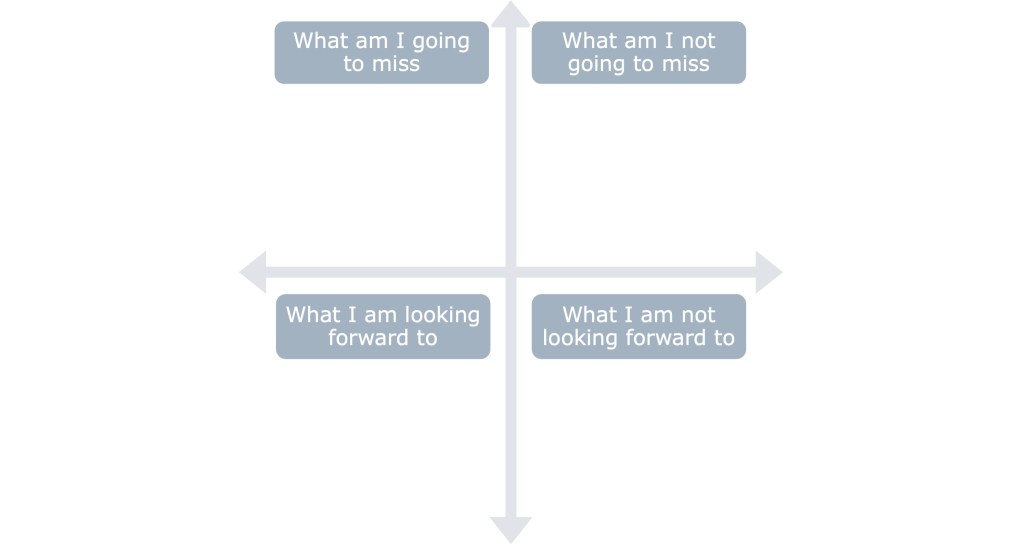
I encourage you to set up the chart illustrated below. This tool facilitates each member of the family sharing about those people, places and things that they will miss (and not), as well as what they are looking forward to (and not) as they anticipate coming ‘home’. For example, butcher paper or similar could be placed on the wall next to the dining table and once a week and so each family member can draw or write on it during a discussion.  Making scrapbooks and powerpoint presentations are alternative tools which can be used.

Janet also sent the book ‘Burn Up or Splash Down: Surviving the Culture Shock of Re-entry’ by Marion Knell to Fred and Megan.

Janet delegated some items on the follow-up checklist such as checking that the families’ accommodation was satisfactory and provision of an adequate car.

Heather said to Janet:

After their arrival, when visiting the families, ask ‘How are you going?’, at the start of each visit or communication. Then listen to whatever they want to talk about. Listening is a powerful gift of care. Sometimes, reactive care may then be appropriate.

As opportunity arises, use the follow-up checklist suggestions as a guide for discussion. Using the checklist, reduces the risk that you might forget an important element of follow-up. However, you should not take the checklist into visits since cross-cultural workers may feel depersonalised by this practice. 

As set out in the follow-up checklist, Janet offered the families a choice of member care worker, providing the families with more agency and an opportunity of a better ‘fit’ with their member care worker.

Within 48 hours of arrival, Janet visited the families to welcome them and informally assess how they were. Unfortunately, John was not fit for work commitments and needed medical leave. Practical assistance was required for Fred and Megan, so Janet directed them to their ‘home’ church who were well resourced to provide this care.  

A couple of weeks after their arrival, Janet visited the families and offered internal personal debriefs (as suggested in the follow-up checklist). Both families preferred to have these informally done. At the beginning, Janet explained the confidentiality arrangement so they were aware of any flow of information occurring. During these internal personal debriefs, Janet made sure she asked them about their physical, mental, emotional, social and spiritual health. Listening to their story was core to this member care provision. Read about how to conduct an internal personal debrief at the Debriefing blogpost

Janet also encouraged the families to have external personal debriefs. She said, 

It is standard practice to have an external debrief during ‘home’ leave and the sending organisation covers all costs incurred. The debriefers will not report back to your sending organisation. In this way, they can provide a safe place for complete openness without any risk of repercussions.

A fringe benefit of this pattern is that cross-cultural workers have established a relationship with a counsellor which makes it easier for them to consult them about any issues in the future. If for some reason the cross-cultural workers don’t find the relationship with the counsellor productive (eg. they don’t ‘click’), the member care worker can provide the cross-cultural workers with a list of alternative counsellors. More can be read about external personal debriefs at the Debriefing blogpost.

A couple of months after their arrival Janet attended the families’ organisational debriefs, so that she was aware of any issues arising. Organisational debriefings provide a means to capture valuable information about the cross-cultural worker’s experience for the benefit of the organisation’s effectiveness in sending cross-cultural workers in the future. Since those leading organisational debriefs are in management roles within the sending organisation, conflicts of interest exist which can impact the pastoral effectiveness of the debrief.

During Fred and Megan’s organisational debrief, it became apparent some conflict existed with organisational management. In this case, the internal personal debrief from the member care worker, as well as the external pastoral care debrief, will be more important than usual.

During the family’s time on ‘home’ leave Janet regularly touched base with the families, whether by phone or visiting, according to their wishes.

She encouraged both families to reflect now on what they are missing (or not) and what they liked (or not) at ‘home’ using the chart pictured below (in a similar way to the previous one).

Janet gave to Fred and Megan the workbook, ‘Returning Well: Your Guide to Thriving Back ‘Home’ After Serving Cross-Culturally’ by Melissa Chaplin

She said, “This workbook is a great resource to work through with a friend, preferably someone who has been through re-entry recently.

Both couples selected to work through the book ‘The Seven Principles for Making Marriage Work’ by John Gottman and Nan Silver, as their marriage enrichment option.

Janet organised monthly gatherings of cross-cultural workers for Bible study, prayer and a meal, facilitating fellowship within that community. She also organised men’s and women’s retreats every six months, as well as occasional social events and TCK (third culture kid) events including ten-pin bowling or trampolining. Janet considered delegating the organising of these events due to a lack of time.Follow-up of cross-cultural workers in final re-entry, like Fred, Megan and their children, can profitably continue for a number of years, although contact will typically decrease in frequency over time.

Janet’s follow-up of the families resulted in both families being better resourced for the future.

* All names of people and places in this blog have been changed to provide anonymity.

Acknowledgements

Thank you to David Bird for his editorial assistance.

References

Ash, C. (2017) Zeal Without Burnout: Seven Keys to a Lifelong Ministry of Sustainable Sacrifice. U.K.: The Good Book Company.

Austin, C. (1983) ‘Re-entry Stress: The Pain of Coming Home’, Evangelical Missions Quarterly, 19(4).

Chaplin, M. (2015) Returning Well: Your Guide to Thriving Back ‘Home’ After Serving Cross-Culturally. Singapore: Newton Publishers.

Dallman, J. (2021) Staying Well: Highlighting Hazards, Highlighting Health for Missionaries in Japan.

Ennis, L. and Brian, L. (2017) Receiving Them Well: A Guide on How to Support Your Loved One Returning From Humanitarian Aid or Missionary Work. USA.

Knell, M. (2006) Burn Up or Splash Down: Surviving the Culture Shock of Re-entry. Downers Grove, IL: Intervarsity Press.

Koteskey, R.L. and Koteskey, B. (2007) ‘We’re Going Home: Reentry for Elementary Children’. New Hope International Ministries. Available at: http://www.missionarycare.com/ebooks/Childrens_Reentry_Book.pdf.

Macnaughtan, H. (2006) Re-Entry the Home Coming Missionary: Can a Sending Church be a Successful Receiving One? Macnaughtan, Helen. Available at: https://books.google.com.au/books?id=crBfPQAACAAJ.

O’Donnell, K. (ed.) (2002) Doing Member Care Well: Perspectives and Practices From Around the World. Pasadena, CA: William Carey Library.

Peterson, E. (2004) ‘The Pastor’s Sabbath’, Christianity Today, May.

How to resource new member care workers

First of all I would check that the new member care worker has read basics such as:

  • Families on the Move by Marion Knell
  • Burn-Up for Splash Down by Marion Knell

Next, I would recommend they read the books used as resources for cross-cultural workers.

Lastly, I would arrange for all members of your member care team to have access to the books listed below as resources for them to consult as needed. Books that I have found most helpful are those about general member care, risk, spirituality, abuse and pastoral theology.

General

  • Doing Member Care Well edited by Kelly O’Donnell
  • Worth Keeping: Global Perspectives on Best Practice in Mission Retention by Rob Hay

Families

  • The Grief Tower: A Practical Guide to Processing Grief with Third Culture Kids by Lauren Wells
  • The Family in Mission: Understanding and Caring For Those Who Serve edited by Leslie Andrews
  • Bear Cards: Feelings by John Veeken (not a book but a set of cards)

Identity

  • Belonging Everywhere and Nowhere: Insights Into Counseling the Globally Mobile by Lois Bushing

Risk

  • Facing Danger: a Guide through Risk by Anna Hampton

Spirituality

  • Spirituality in Mission by Amalraj J. et al

Abuse

  • Child Sexual Abuse in the Churches by Patrick Parkinson
  • Why Does He Do That? by Lundy Bancroft

Pastoral Theology

  • Skilful Shepherds: An Introduction to Pastoral Theology by Derek J. Tidball

Have you any suggestions of other books to recommend for new member care workers? Please comment below.

Updated: July 31, 2023

How to resource cross-cultural workers

I purchased the books listed below and took them with me when visiting cross-cultural workers during ‘home’ leave. Then the cross-cultural workers could borrow those most appropriate for them. Books that were most often helpful were those about re-entry, burnout, resilience, marriage, intercultural marriage, singleness in mission, spiritual health, anxiety, stress, third-culture kids, forgiveness and pornography.

Re-entry

  • Burn-Up for Splash Down by Marion Knell
  • Returning Well: Your Guide to Thriving Back “Home” After Serving Cross-Culturally by Melissa Chaplin (a workbook – typically I suggest that they try to find someone also in re-entry to work through it with)
  • Receiving Them Well: A Guide on How to Support Your Loved One Returning from Humanitarian Aid or Missionary Work by L. and B. Ennis

Transition

  • Families on the Move by Marion Knell
  • Life In Motion: Growing Through Transitions by Ruth Van Reken and Amy Casteel
  • Uprooted: A Guide For Homesick Christians by Rebecca Van Dodewaard
  • Homesick: My Story by Jean Fritz
  • Moving House: Bible Readings For Special Times by Catherine Hickey

Burnout/Resilience

  • Unloading the Overload: A Christian Guide to Managing Stress by Cliff Powell and Graham Barker
  • Zeal Before Burnout by Christopher Ash
  • Healthy, Resilient and Effective in Cross-cultural Ministry by Laura Mae Gardner
  • Going the Distance by Peter Brain

Marriage

  • The Seven Principles for Making Marriage Work by John Gottman and Nan Silver
  • Married for God by Christopher Ash

Intercultural Marriage

  • Your Intercultural Marriage by Marla Alupoaicei
  • Intercultural Marriage: Promises and Pitfalls, 3rd Edition by Dugan Romano

Singleness in Mission

  • Single Mission by Debbie Hawker and Tim Herbert

Spiritual Health

  • A Praying Life by Paul Miller
  • Listening to God by Joyce Huggett

Anxiety/Stress

  • 10 Best Ever Anxiety Management Techniques by Margaret Wherenberg
  • The Anxiety Cure:  You Can Find Emotional Tranquillity and Wholeness by Archibald Hart 
  • The Hidden Link Between Adrenaline and Stress by Archibald Hart
  • The Happiness Trap: Stop Struggling, Start Living by Russ Harris 
  • Mindfulness: An Eight-Week Plan for Finding Peace in a Frantic World by Mark Williams and Danny Penman
  • Helping Kids Cope With Change, Stress and Anxiety: A Photocopiable Book by Deborah Plummer

Third Culture Kids

  • Third Culture Kids: Growing Up Among Worlds: The Original Class Book on TCKs by David Pollock, Ruth Van Reken and Michael Pollock
  • The Grief Tower: A Practical Guide to Processing Grief with Third Culture Kids by Lauren Wells
  • Misunderstood: The Impact of Growing Up Overseas in the 21st Century by Tania Crossman
  • Raising Resilient MK’s: Resources for Caregivers, Parents, and Teachers edited by Joyce Bowers
  • Emotional Resilience and the Expat Child: Practical Storytelling Tips That Will Strengthen the Global Family by Julia Simens
  • 7 Tools For Cultivating Your Child’s Potential by Zan Tyler
  • Serving at the Ends of the Earth: Family Life and TCKs by Steve and Gill Bryant
  • Helping Kids Cope With Change, Stress and Anxiety: A Photocopiable Book by Deborah Plummer
  • When Children Grieve: For Adults to Help Children Deal with Death, Divorce, Pet Loss, Moving and Other Losses by John James and Russell Freedman
  • Bear Cards: Feelings by John Veeken (a set of cards used to facilitate children sharing feelings)

Forgiveness

  • Forgive & Forget by Lewis Smedes

Pornography

  • IP: DIY – Internet Pornography: Do-it-yourself treatment guide for men by Phil Watts
  • Captured by a Better Vision: Living Porn Free by Tim Chester

Have you any suggestions of other books to recommend for cross-cultural workers? Please comment below.

Updated: July 31, 2023

How to resource TCK’s (and their parents)

I purchased the children’s books listed below (pre-school, primary school and teens) and took them with me when visiting families during ‘home’ leave. Then children and parents could borrow those that were most appropriate. Books that were most often helpful were stories about children moving, living in two worlds, friendship, difference, feelings, anxiety, change, identity, sexuality and porn-proofing children.

Preschool books (some suitable for lower primary school)

Leaving home

  • We’ll Still be a Family by Linsey Painter
  • Harold and Stanley Say Goodbye by Jill Dyer (OMF)
  • Alice and the King’s Quest by David and Emily Grace
  • Sammy’s Next Move by Helen Maffini
  • Alexander, Who’s Not (Do you hear me? I mean it!) Going to Move by Judith Viorst
  • Gila monsters meet you at the airport by Marjorie Weinman Sharmat
  • The Berenstain Bears’ Moving Day by Stan and Jan Berenstain
  • Oh, the Places You’ll Go! by Dr. Seuss
  • God is with You: That is All You Need by Larry Libby
  • Off We Go Workbook (OMF)

Living in two worlds

  • Lewis’s Interesting Life by Anna Brotherson and Sara Ang

Friendship

  • How to Be a Friend by Laurie Kransy Brown and Marc Brown

Difference

  • We’re Different, We’re the Same by Bobbi Jane Kates

Feelings

  • How are you Peeling? Foods with Moods by Saxton Freyman and Joost Elffers
  • God Gave Me Feelings by Catherine MacKenzie

Anger

  • Let’s Talk About Feeling Angry by Joy Berry

Pornography

  • Not for Kids! by Liz Walker
  • Good Pictures, Bad Pictures: Porn-Proofing Today’s Young Kids by Kristen Jenson and Gail Poyner

Primary school books

Anxiety

  • What to Do When You WORRY Too Much: A Kid’s Guide to Overcoming Anxiety by Dawn Huebner (Ages 6-12)
  • The Worry Tree by Marianne Musgrove
  • Hey Warrior: A Book for Kids About Anxiety by Karen Young

Change

  • Who Moved My Cheese? For Kids by Spencer Johnson, M.D. and Christian Johnson

Friendship

  • Amber Brown is Not a Crayon by Paula Danziger

Teen books

Grief

  • The Grief Tower: A Practical Guide to Processing Grief with Third Culture Kids by Lauren Wells

Change

  • Who Moved My Cheese? For Teens by Spencer Johnson, M.D. and Christian Johnson
  • Home Keeps Moving by Heidi Sand-Hart

Leaving well – RAFT

  • Burn Up or Splash Down: Surviving the Culture Shock of Re-entry by Marion Knell (the RAFT process is explained on p105-109)

Anxiety

  • Hey Warrior: A Book for Kids About Anxiety by Karen Young

Identity

  • Misunderstood: The Impact of Growing Up Overseas in the 21st Century by Tania Crossman
  • Rice, Noodles, Bread or Chapati: The Untold Stories of Asian MK’s edited by Polly Ho
  • Half and Half by Lensey Namloka
  • Between Two Worlds by LeAnne Hardy
  • Scamps, Scholars and Saints by Jill and Roger Dyer
  • …And Bees make Honey by Jill and Roger Dyer
  • Third Culture Kids: Growing Up Among Worlds: The Original Class Book on TCKs by David Pollock, Ruth Van Reken and Michael Pollock
  • Kids Without Borders: Journals of Chinese Missionary Kids by OMF

Re-entry

  • Re-Entry by Rosanne Hawke
  • Footsteps Around the World: Relocation Tips for Teens by Beverly D. Roman
  • The Global Nomad’s Guide to University Transition by Tina Quick
  • Tear Soup: A Recipe for Healing after Loss by Pat Schwiebert and Chuck DeKleyn
  • Burn Up or Splash Down: Surviving the Culture Shock of Re-entry by Marion Knell

Sexuality

  • Growing Up By the Book by Patricia Weerakoon
  • Teen Sex By the Book by Patricia Weerakoon

Pornography

  • IP: DIY – Internet Pornography: Do-it-yourself treatment guide for men by Phil Watts
  • Captured by a Better Vision: Living Porn Free by Tim Chester

Online Resources 4 TCKs regarding pornography

Kids and Pornography: Using Internet Accountability to Protect and Teach Your Children (Video, parents) – http://www.covenanteyes.com/2012/09/13/how-to-talk-to-kids-about-pornography/

EducateEmpowerKids (Website/Blog, parents) – 

http://educateempowerkids.org/category/healthy-sexuality/ 

What’s the problem with pornography?  It’s bigger than lust, and more than just disobeying the Bible (Webpage, youth) – http://fervr.net/teen-life/whats-the-problem-with-pornography/

Guilty Pleasure (Website, adult) – Focused towards directing people to course and programs that will help them recover from their addiction. – https://guiltypleasure.org/about/

Have you any suggestions of other books to recommend for cross-cultural workers? Please comment below.

Updated: July 31, 2023

Debriefing

“How do I debrief Fiona?  I have no idea where to start!” Jane* exclaims. 

Fiona, a cross-cultural worker, has just arrived back from Albania* where she had a very challenging assignment. She is due to have her personal debriefing soon. Jane just started working as a member care worker for Fiona’s sending organisation and is speaking to her supervisor, Heather*.  

Jane herself returned from cross-cultural work a couple of years ago and had a poor experience of being debriefed herself.  She remembers thinking her debriefer hadn’t a clue about what she had been through and didn’t know what questions to ask. She is concerned not to repeat that experience for Fiona.

What would you say or do?

Analysis

Definitions

Debriefing is telling our story, complete with experiences and feelings, from our point of view. It is a verbal processing of past events… Debriefing is an opportunity to share in depth recent experiences with someone who is willing to listen and care, without judgement or criticism. 

Williams (1995: 1)

Personal debriefs are distinct from organisational and critical incident debriefings. A critical incident debriefing is a highly structured form of personal debriefing, which can take place after a traumatic experience (Hawker, 2012: 2). An organisational debriefing provides a review of an assignment from a factual perspective and gives feedback to the sending organisation (Hawker, 2012: 2). In an organisational debrief, the organisation is the client, while in a personal debrief, the cross-cultural worker is the client (Bosch 2014: 173).  

Internal and external personal debriefs

Personal debriefs can be conducted by personnel within the sending organisation (internal), or from outside the sending organisation (external); each has accompanying advantages and disadvantages.

While Hawker (2012: 18) suggests offering either an internal or an external personal debrief to each cross-cultural worker, I recommend offering both since each offers benefits.

The internal debriefer understands the organisations policies and procedures, can pick up trends, have influence on the future policy and practice of the organisation and follow up issues, but the challenge is to avoid being seen as part of management (Bosch 2014: 167). On the plus side, Donovan and Myors (2002: 304) argue that it ‘is vital that the listener be in a position to bring about change or at least to give feedback about why change cannot be made’.

On the other hand, an external debriefer provides an opportunity for a cross-cultural worker to be debriefed without any conflicts of interest, as long as no feedback will be given to the sending organisation. Thus, an external debriefer can be shared with openly, without negative consequences on the cross-cultural worker and their career (Bosch 2014: 167). An external personal debrief is best conducted by a counsellor who has been a cross-cultural worker in the past, since they are likely to have greater understanding of the cross-cultural worker’s situation. 

Purpose of a personal debriefing

Personal debriefings can help cross-cultural workers to thrive and grow and show value and care for them by their sending organisations. 

Research suggests that personal debriefings can be highly beneficial (Hawker, 2012:13). 

Hay et al (2007: 381) studied six hundred missionary organisations and found that debriefing during home assignment correlated with retention. This research also found that about 40% of aid workers develop a psychological disorder while on location or after returning to their passport country (Hay et al., 2007: 386). Personal debriefings, conducted well, may significantly reduce this figure.

Thus, personal debriefing is important for all cross-cultural workers and yet Hay et al. (2007: 386) found that it is not always happening. Worryingly, Hawker (2012: 4) writes that 48-78% of cross-cultural workers report receiving no or inadequate personal debriefing. 

Such debriefings provide an opportunity for cross-cultural workers to tell their stories. Telling stories is a powerful tool which assists cross-cultural workers to verbally process their experiences including their emotions. Since many people only want to hear positive stories, personal debriefing provides an opportunity to reflect on the dark sides of the cross-cultural worker’s experiences.

The personal debrief aims to help cross-cultural workers to ‘integrate their experience into their life as a whole, perceive the experience more meaningfully, and bring a sense of closure’ (Hawker, 2012: 2). 

Personal debriefing can also provide opportunity for normalisation; the reassurance that some difficulties of adjustment are normal (Hawker, 2012: 5). More on normalisation can be found at The New Normal blogpost

Underlying issues can be identified during personal debriefings and then appropriate referrals for counselling or to a mental health professional can be made. Personal debriefing does not involve counselling or performance evaluation; these should be kept separate (O’Donnell and O’Donnell, 2002: 316).  

Done well, personal debriefings are a valuable form of pastoral care. 

Confidentiality

Cross-cultural workers need a safe space to be able to tell their stories openly and so receive maximum benefit from the personal debrief. Member care workers need to have negotiated with the sending organisation a confidentiality agreement that provides this safe space.   

Feedback to the sending organisation is a challenging issue, attempting to balance the confidentiality promised with the leadership’s responsibility for the welfare of the cross-cultural worker. It requires skill to avoid breaking confidentiality (Bosch 2014: 167). 

In this space, member care workers can assist cross-cultural workers to clarify their thinking and encourage them to speak to leadership themselves. Member care workers can ask the cross-cultural worker to share the ‘need to know’ issues with those who, in fact, do need to know (Bosch 2014, 184). It is important for member care workers not to speak on a cross-cultural worker’s behalf (unless a third party is required for cultural reasons), especially when there are disagreements between them and leadership (Bosch, 2014: 185). 

Code of Best Practice

The Evangelical Fellowship of Canada Code of Best Practice in Member Care provides a benchmark to guide organisational policies and practices for the care and development of cross-cultural Christian workers (O’Donnell, 2002: 272-276) and it stipulates,

Debriefing, including physical, psychological, ministry, and pastoral concerns, is required and provided…

Confidentiality is respected and balanced with accountability to the organisation, sending church, supporters, and other members.

Confidentiality and all related issues are clearly defined and made known to all parties involved

O’Donnell (2002, 274-5)

Timing and structure

The timing of a personal debrief has an impact on its efficacy. Often cross-cultural workers are busy in the first couple of weeks with urgent matters including medical check-ups, catching up with family and other practical matters. Between one and three weeks after arrival is often the best time for a personal debrief. 

A personal debrief routinely takes at least two hours. Hawker (2012: 6-7) points out that short debriefs may be worse than nothing at all, so it is important to allow enough time.  

Personal debriefs can be structured or unstructured.  If the cross-cultural worker has a lot to talk about or would prefer a informal debriefing, an unstructured debrief may be most appropriate; otherwise the use of personal debriefing questions provides structure (Bosch, 2014: 174). As Hoffman (2023) notes, cross-cultural workers from more collectivist cultures tend to prefer informal debriefings; these could be held over a meal or while sitting in a park.

Standard practice

Personal debriefs should be offered as a standard practice with an opt out option. Sometimes cross-cultural workers think they don’t need a personal debrief or that it is a sign of weakness to ask for one. Thus, only providing debriefing for those who ask for it often means that those who need it don’t get it (Hay et al., 2007: 386). 

Choice of debriefer

A person skilled in the area can pick up signs of depression, discouragement, burnout, marital disharmony, and other issues. If such things are addressed early and competently, they can salvage [cross-cultural worker’s] careers. Task-orientated, cognitive concrete thinkers are often not well suited to this ministry. It needs sensitivity to body language, the capacity to read between the lines, and the ability to reflect empathetically upon what is being said. 

Donovan and Myors, 2002: 304

Although Bosch (2014: 153) argues that ‘anyone with two ears’ can debrief, Hawker (2012: 9-10) argues, cross-cultural workers prefer an experienced debriefer, one who demonstrates understanding and who has ‘credibility’. Cross-cultural workers are looking for someone who has had a similar experience and has come out the other side.  

[Debriefers need to] have adequate training in the skills of debriefing, have good listening skills, and are warm, non-judgemental, affirming and able to empathise. They must be able to maintain confidentiality. They should be comfortable with silence, as sometimes debriefees require time to reflect before speaking. They should also be able to sit with people who are showing strong emotion (e.g. crying or feeling angry). Debriefers need to recognise their own limitations, and be willing to refer people on for further help if necessary. They should receive supervision.

Hawker (2012: 17-18)

Further, Fawcett (1999: 90) argues that cross-cultural workers are looking for companionship, which is generated by being with those who have common vulnerabilities. 

Cross-cultural workers are also looking for someone who has the power, or perceived ability, to influence future events, who can answer questions and point them in the right direction (Hawker, 2012:10). The internal debriefer needs to be trusted by management (Fawcett 1999: 64).  The member care worker also needs to be able to trust the cross-cultural workers to act responsibly should the need arise.  

Dangers of debriefing

It is possible to add to a cross-cultural worker’s pre-existing trauma during a debriefing. Asking questions of cross-cultural workers may pressure them to talk about experiences that are unhelpful for them to recall.  However, if the member care worker allows the cross-cultural worker to lead the conversation, the possibility of this danger can be reduced. Group debriefings of cross-cultural workers who have had traumatic experiences are particularly problematic since one cross-cultural worker may share an aspect of the trauma not experienced by another and so add to the trauma the other has already experienced.  

It is also important to end the debriefing well. Ending without closure leaves the cross-cultural workers vulnerable. Hoffman (2023) suggests that member care workers ask cross-cultural workers what might be a helpful next step for them. Sometimes offering resources is a good way forward. It is also important for the member care worker to honour the cross-cultural workers’ openness in sharing to provide validation.

Let’s now reflect on a similar story in the Bible.

A story to consider

That same day two of Jesus’ followers were going to a village called Emmaus. It was about seven miles from Jerusalem. They were talking with each other about everything that had happened. As they talked about those things, Jesus himself came up and walked along with them. But God kept them from recognizing him.

Jesus asked them, “What are you talking about as you walk along?”

They stood still, and their faces were sad. One of them was named Cleopas. He said to Jesus, “Are you the only person visiting Jerusalem who doesn’t know? Don’t you know about the things that have happened there in the last few days?”

“What things?” Jesus asked.

“About Jesus of Nazareth,” they replied. “He was a prophet. He was powerful in what he said and did in the sight of God and all the people. The chief priests and our rulers handed Jesus over to be sentenced to death. They nailed him to a cross. But we had hoped that he was the one who was going to set Israel free. Also, it is the third day since all this happened. Some of our women amazed us too. Early this morning they went to the tomb. But they didn’t find his body. So they came and told us what they had seen. They saw angels, who said Jesus was alive. Then some of our friends went to the tomb. They saw it was empty, just as the women had said. They didn’t see Jesus’ body there.”

Jesus said to them, “How foolish you are! How long it takes you to believe all that the prophets said! Didn’t the Messiah have to suffer these things and then receive his glory?” Jesus explained to them what was said about himself in all the Scriptures. He began with Moses and all the Prophets.

They approached the village where they were going. Jesus kept walking as if he were going farther. But they tried hard to keep him from leaving. They said, “Stay with us. It is nearly evening. The day is almost over.” So he went in to stay with them.

He joined them at the table. Then he took bread and gave thanks. He broke it and began to give it to them. Their eyes were opened, and they recognized him. But then he disappeared from their sight. They said to each other, “He explained to us what the Scriptures meant. Weren’t we excited as he talked with us on the road?”

Luke 24: 13-32

 After appearing to the disciples, Jesus first chooses to offer them an opportunity to tell their story. Jesus listens to the disciples’ story before he offers them an alternative understanding of the events they had experienced, assisting them to put their experiences into context (Hawker 2002: 472).

What happened? How was this cross-cultural worker cared for?

Heather (Jane’s supervisor) suggested that Jane read the materials listed in the ‘Recommended Reading’ below.  These materials provide in-depth and practical information about how to debrief well.

Heather suggested that Jane offer Fiona a two-three hour internal personal debriefing about a fortnight after she arrives ‘home’, as well as ensuring that the venue provides privacy and an environment free of interruptions.

Heather suggested that prior to Fiona’s debriefing, Jane explain the purpose, benefits and expectations of the debriefing process, so that Fiona had time to prepare for it (Bosch, 2014: 179).

Heather provided Jane with a confidentiality blurb which she could use to inform Fiona of the confidentiality arrangement (the flow of information) at the start of the debrief.

Prior to the debrief, Heather suggested Jane read the ‘Listening Well’ blog post. 

Heather provided a list of personal debriefing questions for Jane to use as appropriate and reminded her that Fiona might prefer a very informal debrief.

At the end of the debrief, Heather said that Jane could ask Fiona,

“What would help you to move on?”

She also suggested that the offer of a external personal debrief with a counsellor might be part of resourcing Fiona to move on.

Finally, Heather suggested that Jane honour Fiona’s vulnerability by saying,

“Thank you for sharing your story with me. Thank you for your courage in sharing so openly with me.”

* All names of people and places in this blog have been changed to provide anonymity.

Acknowledgements

Thank you to David Bird for his editorial assistance.

Recommended Reading

Bosch, B. (2014) Thriving in Difficult Places. Pretoria, South Africa: Author (Chapter 4)

Hawker, D. (2012) Debriefing Aid Workers and Missionaries: A Comprehensive Manual. Ninth Ed. People in Aid. Available at: https://books.google.com.au/books?id=YVcpMwEACAAJ.

Hoffmann, H. Advanced Debriefing Skills (2023). (C.A.R.E.: Member Care Growth, Mastery & Beauty).

References

Bosch, B. (2014) Thriving in Difficult Places. Pretoria, South Africa: Author.

Donovan, K. and Myors, R. (2002) ‘Reinventing Missionary Commitment’, in K. O’Donnell (ed.) Doing Member Care Well: Perspectives and Practices From Around the World. Pasadena, CA: William Carey (Globalization of Mission Series), pp. 295–307.

Fawcett, G. (1999) Ad-mission: The Briefing and Debriefing of Teams of Missionaries and Aid Workers. Harpenden, UK: Author.

Hawker, D. (2002) ‘Guidelines for Crisis and Routine Debriefing’, in Doing Member Care Well: Perspectives and Practices From Around the World. Pasadena, CA: William Carey Library (Globalization of Mission Series), pp. 457–475.

Hawker, D. (2012) Debriefing Aid Workers and Missionaries: A Comprehensive Manual. Ninth Ed. People in Aid. Available at: https://books.google.com.au/books?id=YVcpMwEACAAJ.

Hay, R. et al. (2007) Worth Keeping:Global Perspectives on Best Practices in Missionary Retention. Pasadena, CA: William Carey.

O’Donnell, K. (ed.) (2002) Doing Member Care Well: Perspectives and Practices From Around the World. Pasadena, CA: William Carey Library.

O’Donnell, K. and O’Donnell, M.L. (2002) ‘Running Well and Resting Well: Twelve Tools for Missionary Life’, in Doing Member Care Well: Perspectives and Practices From Around the World. Pasadena, CA: William Carey Library (Globalization of Mission Series).

Good Grief!

Our family’s time overseas was overwhelmingly positive and fruitful.  It was a difficult decision to leave Peru but we had a calm and planned return to Australia.  Deputation went smoothly; it was a valuable time saying goodbye to our supporters.”   Ross* enthusiastically spoke to Liz*, his member care worker. 

Ross and his family had just landed back ‘home’ in Sydney, after ten years and he was eagerly anticipating starting an exciting new job.  Despite their auspicious start, Ross found coming back to Australia discombobulating, especially for the first year.  The following couple of years were also difficult. 

Ross spoke with great feeling about the grief he felt at leaving dear friends behind in Peru.  As well as losing those wonderful relationships, he expressed grief about the loss of the fruitful ministry he and his family had been involved in.

Ross found it really difficult adjusting to Australian culture. He recalled,

For my work orientation, a colleague seemed to have barely started the conversation when he finished and walked away.  I was left feeling really perplexed.  In Peru, a work orientation would have been given hours!  Peruvian culture is much more relationship orientated than task orientated.   Spending such a short amount of time orientating someone to a new job would be considered extremely rude.

Another day, I was walking down a street when some guys behind me started speaking really aggressively.  I thought they were about to get into a physical fight, so I turned around, bracing myself, only to see that they were just horsing around!  In Peru, people would only speak that aggressively when very angry.

I also found it really difficult to know how to greet people.  In Peru, I knew when to shake hands and when to kiss, and who to do what with.  However, in Australia I just didn’t know what to do.  I felt like I didn’t fit in.  This cultural dislocation was hard.

After two years, Ross was really thrilled to be invited back to Peru for a fortnight to speak at a conference and visit friends.  He jumped at the chance to return, to join old work colleagues and friends there.  After he returned to Australia, he said, 

I felt so much more at home in Peru.  This was really unsettling and it rocked me a bit, particularly how much more at ease I was in relationships there.

What would you do or say in this situation?

Analysis

Re-entry

Ross and his family are in the thick of re-entry, with many adjustments to make during their transition to life back in Sydney.  Re-entry refers to the time when we leave a place where we have been serving cross-culturally and return to the place we were originally from, our ‘home’ country.  It is a form of culture shock, but in reverse.

As part of culture shock, cross-cultural workers commonly experience a feeling of alienation when they first arrive in another culture, and this is repeated during re-entry.  Feeling alien in our own culture is the essence of re-entry stress. Cross-cultural returnees often say, “We look and sound like everyone else, but inside we feel different.”  This sense of alienation is often not expected.  

When missionaries enter [a cross-cultural location], they expect to have difficulty with language, religions of the host culture, attitudes of national Christians, nostalgia for [‘home’], and maintaining their own spiritual adjustment. Who would ever expect to feel like a stranger in his own country? 

The groundwork for this obstacle is often laid during the initial phases of culture shock. When difficulties with culture shock arise, expatriates tend to “glorify” institutions and traditions of their home country. However, when [cross-cultural workers] return, they do not experience [‘home’] as they had remembered it… The psychological discomfort resulting from this conflict can be harsh.

Austin (1983)

 Re-entry is typically more challenging than the culture shock experienced when first moving into another culture, and is often underestimated.  In anticipation of their return, cross-cultural returnees commonly say, 

It won’t be that challenging!  After all, we’re Australians, aren’t we?  It should be easy coming home. Isn’t it?”  

Neither cross-cultural returnees, nor their home churches, expect the returnees’ adjustment to life back ‘home’ after cross-cultural service to be more difficult than their initial adjustment to their cross-cultural location (Pirolo, 2012).  Sometimes even their sending organisation aren’t expecting this, particularly when staffed by those with little relevant experience.  

As well as the shock of re-entry being enhanced by these disappointed expectations of the home country, they are also enhanced by bereavement reactions  (Foyle, 1987).  

Grief

I’m grieving.  There’s been a lot of change, a lot of saying goodbye.  It feels like I left part of me in a different place, and I’ll never be the same again.  So, if it seems like I’m crying for no reason over little things, it’s because I have to walk through the process of mourning things I’ve lost.  I know I said goodbye in my last country, but I’m finding there is still grieving to do…  I’m saying goodbye to people, places, foods, routines, careers…  

Ruthie (2015)

Ross’ description of his grief is similar to many cross-cultural workers’ during re-entry.  Grief is ‘a natural reaction to loss or change of any kind’ (NA, 2020).   In a study of 288 returned cross-cultural workers, the second most challenging problem identified was ‘nostalgia and homesickness’ for their previous cross-cultural location (Austin, 1983). It is not surprising that grief is a significant part of reentry since so much has been left behind.  Often, significant relationships, roles, routines and rituals have been lost.  In fact, it would be a sad reflection on the investment made in the cross-cultural location, if cross-cultural workers were not grieving after leaving.   

Wide ranging symptoms are experienced during grief.  People are affected physically, emotionally, cognitively, behaviourally and spiritually.  Grief is expressed in various phenomena including headaches, mood fluctuations, poor memory and insomnia (Smith, 2003).  Ross suffered significant migraines and lowered concentration for his first few years back in Australia⁠1.

Listening 

It helps me grieve when you’re willing to listen… to what I’ve lost, to what I miss, to what is hard.  As I talk about it, I find I’m able to grieve it and move on…

Ruthie (2015)

At the risk of stating the obvious, listening is a vital part of a Member Care Worker’s role. Many returnees report that most people aren’t interested in listening to them talk about their former location. Some say, ‘others eyes glaze over very quickly‘. The cross-cultural returnee’s experience of being listened to is greatly enhanced within a relationship of trust, particularly with a non-judgemental person.

Mutual care 

A problem shared is a problem halved.

Traditional saying

As well as listening provided one-to-one by Member Care Workers and others, much benefit may be derived by Member Care Workers organising events which encourage mutual care between cross-cultural workers on home assignment, in re-entry and in location. Mutual care refers to the ‘support, encouragement, correction, and accountability that we give and receive from others’ (O’Donnell, 2002). Connections between cross-cultural workers often facilitates fruitful opportunities for listening, companionship, normalisation,⁠2 and in this way can significantly increase an organisation’s member care capacity.   

If the role of an organisation’s Member Care Worker, or team, is expanded to include the encouragement and facilitation of mutual care, the organisation’s member care provision can be significantly increased.   Former cross-cultural workers, who have been back ‘home’ for a while, as well as those who are going through re-entry at the same time, can be great supports for those in re-entry.  Hearing from others who are going through, or have been through similar experiences, can be a great comfort.  Fellowship with such people can normalise feelings of alienation and grief.

The importance of mutual care is emphasised in International Models of Best-Practice for Member Care, which set out recognised principles and performance standards for the management and support of cross-cultural workers (O’Donnell, 2002).  

A Best-Practice Model for Member Care by Kelly O’Donnell and David Pollock  O’Donnell (2002)

One Code of Best Practice in Member Care recommends that for organisations:

Opportunity is given for member interaction and mutual caring.

Mutual care is planned for, clearly defined, and its importance communicated.

Responsibility for self-care, in community, is modelled and encouraged by leadership.

Evangelical Fellowship of Canada (2002)

Research has confirmed the importance of mutual care as opportunities for self-expression and learning.

A support group can serve as a forum for exchange of information and expression of feelings… Returned missionaries claim that the following individuals, groups, and/or activities were most helpful to them upon reentry, in descending order: spouse, friends, relatives, former missionaries, church members, college missions department personnel, reading materials, personal counseling, church leaders, debriefing with overseeing church personnel, psychological testing and evaluation, reorientation program, and family counseling. 

Austin (1983)

While Member Care Workers, sending organisation staff, home churches, family, friends and professionals can all provide listening, companionship and normalisation, all are limited in various ways.  Member Care Workers, and staff from sending organisations, are a finite resource.   Home churches, family and friends are also important sources of member care but may be limited in specialised areas.  Typically, they may not have sufficient expertise regarding re-entry and Third Culture Kids (TCK), for the purposes of normalisation.  They may also know insufficient about when and who to refer returnees to, when appropriate professional help is required.  Professional debriefs and followup counselling are vital but are also limited by cost and the availability of appropriate professionals.  

Member Care Workers can encourage returnee cross-cultural workers to connect with other returnees for mutual care in a variety of ways.  They can facilitate connection through running events for the returnee community, as well as encourage cross-cultural workers to organise their own events.  Initially, returnees may lack the energy required to organise events themselves.  Typically, they are stretched by a plethora of speaking engagements, travel commitments, family reunions and the usual fatigue associated with any transition.  Member Care Workers can organise various types of community events including Bible study and prayer groups, social events, Third Culture Kid events and retreats for men and women.  

Recruiting and training a team of volunteer Member Care Workers can increase an organisation’s member care provision.  These volunteers can assist in running community events, as well as with pastoral visitation.  Volunteer Member Care Workers who are returnees and have walked the journey themselves, have a significant advantage over those who have not.

A story to consider

It is important that we continue to let the Bible interrogate our understanding.  These blog posts consult the Bible as part of a theological reflection cycle.⁠3

There was a time when Israel didn’t have kings to rule over them. But they had leaders to help them. This is a story about some things that happened during that time.

There wasn’t enough food in the land of Judah. So a man went to live for a while in the country of Moab. He was from Bethlehem in Judah. His wife and two sons went with him. The man’s name was Elimelek. His wife’s name was Naomi. The names of his two sons were Mahlon and Kilion. They were from the tribe of Ephraim. Their home had been in Bethlehem in Judah. They went to Moab and lived there.

Naomi’s husband Elimelek died. So she was left with her two sons. They married women from Moab. One was named Orpah. The other was named Ruth. Naomi’s family lived in Moab for about ten years. Then Mahlon and Kilion also died. So Naomi was left without her two sons and her husband.

While Naomi was in Moab, she heard that the Lord had helped his people. He had begun to provide food for them again. So Naomi and her two daughters-in-law prepared to go from Moab back to her home. She left the place where she had been living.  Her daughters-in-law went with her.  They started out on the road that would take them back to the land of Judah.

Naomi said to her two daughters-in-law, “Both of you go back. Each of you go to your own mother’s home. You were kind to your husbands, who have died. You have also been kind to me. So may the Lord be just as kind to you. May the Lord help each of you find rest in the home of another husband.”

Then she kissed them goodbye. They broke down and wept loudly. They said to her, “We’ll go back to your people with you.”

But Naomi said, “Go home, my daughters. Why would you want to come with me? Am I going to have any more sons who could become your husbands? Go home, my daughters. I’m too old to have another husband. Suppose I thought there was still some hope for me. Suppose I married a man tonight. And later I had sons by him. Would you wait until they grew up? Would you stay single until you could marry them? No, my daughters. My life is more bitter than yours. The Lord’s power has turned against me!”

When they heard that, they broke down and wept again. Then Orpah kissed her mother-in-law goodbye. But Ruth held on to her.

“Look,” said Naomi. “Your sister-in-law is going back to her people and her gods. Go back with her.”

But Ruth replied, “Don’t try to make me leave you and go back. Where you go I’ll go. Where you stay I’ll stay. Your people will be my people. Your God will be my God. Where you die I’ll die. And there my body will be buried. I won’t let even death separate you from me. If I do, may the Lord punish me greatly.” Naomi realized that Ruth had made up her mind to go with her. So she stopped trying to make her go back.

The two women continued on their way. At last they arrived in Bethlehem.

Ruth 1:1-19a

Ruth was a faithful companion to Naomi during her transition back into her home country and as she experienced profound grief at the loss of her husband and sons. Naomi’s grief was multifaceted, including particular challenges for Ruth and Naomi in the culture of the day.  Ruth chose to stay with Naomi despite the significant cost to her which Naomi clearly pointed out.  

What happened? How was this cross-cultural worker cared for?

Liz*, their member care worker, listened to Ross and his family talk about what they were missing from Peru.  Ross and his family reconnected with family, friends and were embraced by their local church, providing many listening opportunities, as well as companionship.  Liz also walked alongside them, providing normalisation when opportunities arose.  Further, she encouraged them to make time to connect with other returned cross-cultural workers, particularly those who had served in a similar cultural context.  Ross reported that these connections were a positive experience for both him and his family.  Liz organised other opportunities for mutual care within the community of cross-cultural workers, both past and present.  These included Bible Study and prayer groups, as well as social gatherings.  

Ten years later Ross reflected:

“It was a very stressful period for the first couple of years after we returned to Australia, and particularly the first twelve months.  After three years I started to feel more settled.  

I still feel like I could happily hop on a plane tomorrow and return to Peru long-term.  

I found 1 Peter 1:1–9 a wonderful comfort in grief, particularly re-entry grief, because of its focus on our eternal home. The positive flipside of cultural dislocation for Christians is being reminded that we are looking forward to our true home. I carried one of those TSA locks on my keyring for years as a reminder.”

You can read more about Ross’ re-entry experience in the blog post ‘Brain Fog’.

* Names of people and places in this blog have been changed to preserve anonymity.

Author’s note

Some practical examples:

During ten years as a sending organisation’s Member Care Worker, I organised a variety of events to facilitate member care for both returnees and cross-cultural workers on home assignment.  The most popular was a monthly gathering for Bible study, fellowship, prayer and an informal meal.  Cross-cultural workers often said, “It feels safer to share more deeply in this setting than in churches or with friends, since this group has so much shared experience.”  Often, organisation staff led the Bible study, since cross-cultural workers were often very stretched.  

Women’s and men’s retreats were beneficial for some.  These provided opportunities for cross-cultural workers to share their stories at greater length, followed by prayer for them.  God used this experience within a safe setting as a powerful healing experience for some.  I outsourced the running of men’s retreats to volunteers [This was part of my organisation’s strategy to expand our Member Care provision by building a member care team].   

I also organised a variety of annual social events using the resources that God provided me, including a number of wonderful volunteers.  These events included sailing days for returnees (all ages), and 10-pin bowling or trampolining events for returned TCKs.  

All of these events encouraged connections throughout the organisation’s returnee community and those cross-cultural workers on home assignment.

Acknowledgements

Thankyou to Ross for granting permission for me to write this blog post and also for his input, providing additional strength.  

Thankyou to Megan Withers for her editorial assistance.

Recommended Reading

Knell, M. (2006) Burn Up or Splash Down: surviving the culture shock of re-entry. Downers Grove, IL: Intervarsity Press.

Ruthie (2015) ‘For Friends & Family of those Moving Back “Home”’, Rocky Re-entry, 11 February.

References

Austin, C. (1983) ‘Re-entry Stress: the Pain of Coming Home’, Evangelical Missions Quarterly, 19(4).

Chaplin, M. (2015) Returning Well: Your Guide to Thriving BAck ‘Home’ After Serving Cross-Culturally. Newton Publishers.

Clark, S. E. (2003) Loss and grief in general practice: the development and evaluation of two instruments to detect and measure grief in general practice patients. University of Adelaide.

Culture Shock (2020) Collins Dictionary. Available at: https://www.collinsdictionary.com/dictionary/english/culture-shock.

Ennis, L. and Brian, L. (2017) Receiving Them Well: a guide on how to support your loved one returning from humanitarian aid or missionary work.

Foyle, M. F. (1987) Honorably Wounded. Europe: MARC.

Knell, M. (2006) Burn Up or Splash Down: surviving the culture shock of re-entry. Downers Grove, IL: Intervarsity Press.

Managing Lockdown Fatigue (2020) Australian Psychological Society. Available at: https://www.psychology.org.au/getmedia/74e7a437-997c-4eea-a49c-30726ce94cf0/20APS-IS-COVID-19-Public-Lockdown-fatigue.pdf.

O’Donnell, K. (ed.) (2002) in Doing Member Care Well: Perspectives and Practices From Around the World. Pasadena, CA: William Carey.

Pirolo, N. (2012) Serving As Senders – Today. Emmaus Road International. Available at: https://books.google.com.au/books?id=_mB6tgAACAAJ.

Rabe, M. (1997) Culture Shock! Living and Working Abroad. Eugene, OR: Wipf and Stock Publishers.

Ruthie (2015) ‘For Friends & Family of those Moving Back “Home”’, Rocky Re-entry, 11 February.

Ward, C., Bochner, S. and Furnham, A. (2001) The Psychology of Culture Shock.

anImage_17.tiff

1 Read more about Ross’s re-entry experience in the ‘Brain Fog’ blog post – https://membercaring.org/2020/09/23/brain-fog-updated/

2 Read more about normalisation in the ‘The New Normal’ blog post – https://membercaring.org/2019/09/11/the-new-normal/

3 Read more about our use of the Bible in the ‘Theological Reflection Cycle’ blog post – https://membercaring.org/2019/09/17/theological-reflection-cycle/