
“How do I follow-up John*, Denise* and their two boys while they are on ‘home’ leave? Another family, Fred, Megan and their children, are also returning for re-entry at about the same time! There may be others! How can I fit the work into my hours?”
Janet* is speaking to Heather, her supervisor. She has just started working as a member care worker.
What would you say or do?
Analysis
What is follow-up?
Follow-up refers to the ‘increase of the effectiveness or success of [something] by further action’ (vocabulary.com). Janet’s follow-up of both families continues the member care provided previously by other member care workers, in addition to the pastoral care provided by their churches.
The follow-up of cross-cultural workers aims to continue to provide effective member care for cross-cultural workers, so that they thrive and grow as children of God. This in turn, means they will serve more effectively, whether on location or back ‘home’. Good member care ‘rests on a theological foundation of godly stewardship of people who are made in the image of God’ (O’Donnell, 2002: 272).
Re-entry
Both families will be experiencing a form of re-entry, the often unexpected reverse culture shock of returning ‘home’. Read more about this at the Good Grief blogpost.
Holistic
Follow-up needs to be holistic, focusing on all aspects of cross-cultural workers’ lives: spiritual, physical, emotional, mental and social. Research regarding chaplaincy (Jones et al., 2018) demonstrated that patients ‘valued having a range of specific needs met by the pastoral care practitioner, including their spiritual needs, friendship/social support needs, and practical needs.’
Common tools of the trade
Member care workers can provide companionship, walking alongside cross-cultural workers during the ups and downs of transition. Morgan (2015) writes that the pastoral care of chaplains provides “a supportive, compassionate presence for people at significant times of transition, illness, grief or loss.”
Member care workers can facilitate member care by the provision of community events with current and former cross-cultural workers. When cross-cultural workers and their families spend time with others with similar experiences, there is much opportunity for mutual care and encouragement.
The importance of mutual care cannot be overstated. Social support and good relationships come out in the research over and over again as being key to adjustment.
Austin (1983)
Listening well is an important skill for member care workers and is a significant gift to cross-cultural workers. Read about how to improve your listening skills at the Listening well blogpost.
Normalisation can be a powerful tool during transition. If whilst listening to the cross-cultural worker, they mention an experience that is similar to the member care worker or another, the member care worker can normalise by saying, “It was similar for …”. However, it is important to be cautious about this practice, since member care workers can cause ‘road blocks’ by assuming that others have the same experience as they had. Listening well helps avoid this obstacle. Read more about normalisation at The New Normal blogpost.
It is important for member care workers to recognise their limitations and to refer to counsellors or psychologists as appropriate.
Preventative and reactive member care
Follow-up provides much opportunity for preventative or proactive care. Follow-up also includes the provision of reactive care for any issues cross-cultural workers raise. However, preventative member care is a worthwhile (and efficient) investment of time, since it reduces the incidents requiring reactive care. It can be likened to a barrier placed at the top off a cliff, preventing cross-cultural workers from falling onto the rocks below and then requiring reactive care. It is similar to preventative health care which involves modification of lifestyle choices to reduce the risk and severity of disease.
Although furloughing cross-cultural workers are only ‘home’ for a few months, much preventative care can be provided during this time. Focusing on preventative member care includes encouraging cross-cultural workers to be proactive about reviewing their self-care practices.
Structures
Member care is often delivered in a rather adhoc fashion but can be improved if more structured. Obviously, reactive care may be needed in response to issues as they arise. However, preventative care can occur in more predictable patterns and so be planned. Dallman (2021, 30) argues for, ‘putting structures in place in advance to ensure missionaries’ good care’.
Various member care structures, put in place by the sending agency and/or the member care workers to facilitate effective preventative care, can provide a safety net for the well-being of the cross-cultural workers. For example, one sending agency uses ‘Pastoral Care Plans’ which are a tool used to facilitate healthy self-care practices. This agency requests that cross-cultural workers prepare a pastoral care plan prior to their departure for location, and regularly review this document. In this way, setting up and reviewing self-care practices is structured systemically. Read more at Pastoral Care of Missionaries: Turning Theory into Practice. Another agency requires all cross-cultural workers have a support group with representatives from the sending agency, family and friends. This group can provide member care during ‘home’ assignment. Many agencies provide allocated leave for refreshment.
What structures are in place for the care of cross-cultural workers in Janet’s agency? Is there time for refreshment built into their ‘home’ leave?
The follow-up practices and the structures that support them should aim to reflect the Code of Best Practice set out below.
Code of Best Practice
The Evangelical Fellowship of Canada Code of Best Practice in Member Care provides a benchmark to guide organisational policies and practices for the care and development of cross-cultural Christian workers (O’Donnell, 2002: 272-276).
Some of the key indicators relating to follow-up of cross-cultural workers during ‘home’ leave are:
O’Donnell (2002: 274-275)
- Debriefing, including physical, psychological, ministry, and pastoral concerns, is required and provided…
- Transition opportunities/seminars, which include cultural issues and issues related to redeployment, re-entry, and retirement, are provided.
- Resources (human and financial) are allocated for follow-up care during re-entry or redeployment…
- Trained caregivers are identified and made available to members when needed.
- Opportunity is given for member interaction and mutual caring…
- Opportunities for marital enrichment and couple retreats are provided and encouraged – both on the field and during home service (furlough)…
- The organisation partners with the local church in a member’s preparation for initial ministry assignment, re-entry, redeployment, and retirement…
Let’s now reflect on a similar story in the Bible.
A story to consider
Moses’ father-in-law Jethro came to Moses in the desert. He was so impressed by God’s provision for Israel that he started to worship God himself.
The next day Moses took his seat to serve the people as their judge. They stood around him from morning until evening. His father-in-law saw everything Moses was doing for the people. So he said, “Aren’t you trying to do too much for the people? You are the only judge. And all these people are standing around you from morning until evening.”
Moses answered, “The people come to me to find out what God wants them to do. Anytime they don’t agree with one another, they come to me. I decide between them. I tell them about God’s rules and instructions.”
Moses’ father-in-law replied, “What you are doing isn’t good. You will just get worn out. And so will these people who come to you. There’s too much work for you. You can’t possibly handle it by yourself. Listen to me. I’ll give you some advice, and may God be with you. You must speak to God for the people. Take their problems to him. Teach them his rules and instructions. Show them how to live and what to do. But choose men of ability from all the people. They must have respect for God. You must be able to trust them. They must not try to get money by cheating others. Appoint them as officials over thousands, hundreds, fifties and tens. Let them serve the people as judges. But have them bring every hard case to you. They can decide the easy ones themselves. That will make your load lighter. They will share it with you. If this is what God wants and if you do it, then you will be able to carry the load. And all these people will go home satisfied.”
Exodus 18:13-23
Jethro encourages Moses to take the burden of the peoples’ problems to God and to share the load with others with suitable skills and gifts.
What happened? How was these cross-cultural workers cared for?
Just as Jethro advised Moses, Janet took the families’ well-being to God in prayer.
In a similar way to Moses, Janet also sought to develop a team of member care workers, whether paid or volunteers, through training and recruitment to assist with the member care work. While she took primary responsibility for the two families, she delegated as much care of the families’ care as appropriate to other member care workers, counsellors and the families’ sending churches. The follow-up of other cross-cultural workers returning from location was delegated to other member care workers. She didn’t try to do it all herself.
Regarding Janet’s follow-up of the two families, Heather, her supervisor, suggested a plan.
Brief timeline of follow-up
- 6 months prior to arrival – send transition resources
- 2 months prior to arrival – ask about member care priorities and mentors, check accommodation
- Within 48 hours after arrival – welcome and check how they are
- 1-3 weeks after arrival – offer internal personal debrief, ask how they are physically, mentally, emotionally, socially and spiritually, ask about their member care priorities and mentors
- 6-8 weeks after arrival – attend organisational debrief (review)
- Subsequent ongoing contact (~ monthly) – phone or visit (eg. debrief children, review pastoral care plan, offer resources including marriage enrichment options)
- Monthly – organise gatherings for Bible study, prayer and lunch, facilitating mutual care
- Occasionally (~ 6 monthly) – organise other community events to facilitate mutual care. For example, women’s and men’s retreats, social events and TCK events
Fleshing out the timeline:
Heather told Janet,
Use this follow-up checklist which has more details for the follow-up of cross-cultural workers.
As set out in the follow-up checklist, Janet sent an email to the families prior to their return ‘home’, writing:
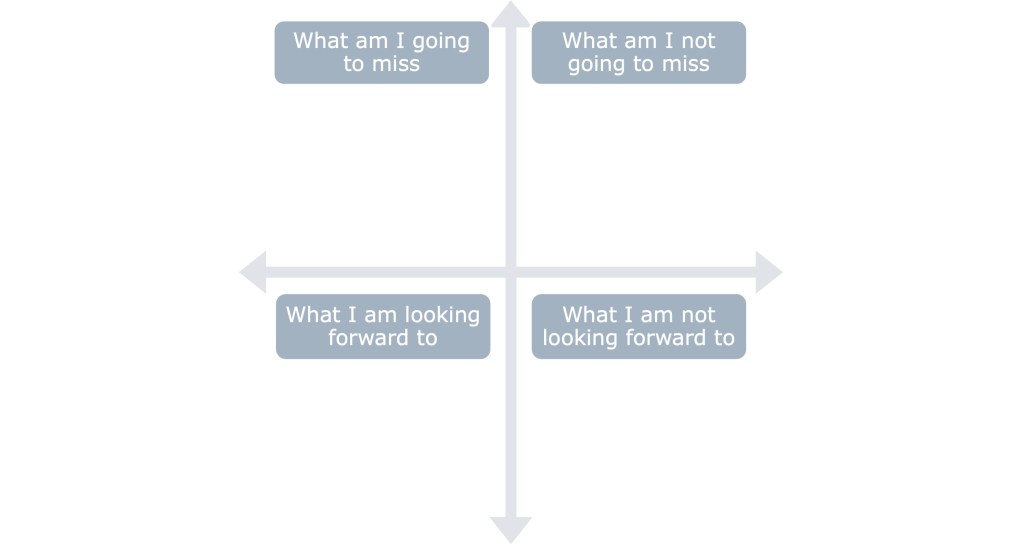
I encourage you to set up the chart illustrated below. This tool facilitates each member of the family sharing about those people, places and things that they will miss (and not), as well as what they are looking forward to (and not) as they anticipate coming ‘home’. For example, butcher paper or similar could be placed on the wall next to the dining table and once a week and so each family member can draw or write on it during a discussion. Making scrapbooks and powerpoint presentations are alternative tools which can be used.
Janet also sent the book ‘Burn Up or Splash Down: Surviving the Culture Shock of Re-entry’ by Marion Knell to Fred and Megan.

Janet delegated some items on the follow-up checklist such as checking that the families’ accommodation was satisfactory and provision of an adequate car.
Heather said to Janet:
After their arrival, when visiting the families, ask ‘How are you going?’, at the start of each visit or communication. Then listen to whatever they want to talk about. Listening is a powerful gift of care. Sometimes, reactive care may then be appropriate.
As opportunity arises, use the follow-up checklist suggestions as a guide for discussion. Using the checklist, reduces the risk that you might forget an important element of follow-up. However, you should not take the checklist into visits since cross-cultural workers may feel depersonalised by this practice.
As set out in the follow-up checklist, Janet offered the families a choice of member care worker, providing the families with more agency and an opportunity of a better ‘fit’ with their member care worker.
Within 48 hours of arrival, Janet visited the families to welcome them and informally assess how they were. Unfortunately, John was not fit for work commitments and needed medical leave. Practical assistance was required for Fred and Megan, so Janet directed them to their ‘home’ church who were well resourced to provide this care.
A couple of weeks after their arrival, Janet visited the families and offered internal personal debriefs (as suggested in the follow-up checklist). Both families preferred to have these informally done. At the beginning, Janet explained the confidentiality arrangement so they were aware of any flow of information occurring. During these internal personal debriefs, Janet made sure she asked them about their physical, mental, emotional, social and spiritual health. Listening to their story was core to this member care provision. Read about how to conduct an internal personal debrief at the Debriefing blogpost.
Janet also encouraged the families to have external personal debriefs. She said,
“It is standard practice to have an external debrief during ‘home’ leave and the sending organisation covers all costs incurred. The debriefers will not report back to your sending organisation. In this way, they can provide a safe place for complete openness without any risk of repercussions.”
A fringe benefit of this pattern is that cross-cultural workers have established a relationship with a counsellor which makes it easier for them to consult them about any issues in the future. If for some reason the cross-cultural workers don’t find the relationship with the counsellor productive (eg. they don’t ‘click’), the member care worker can provide the cross-cultural workers with a list of alternative counsellors. More can be read about external personal debriefs at the Debriefing blogpost.
A couple of months after their arrival Janet attended the families’ organisational debriefs, so that she was aware of any issues arising. Organisational debriefings provide a means to capture valuable information about the cross-cultural worker’s experience for the benefit of the organisation’s effectiveness in sending cross-cultural workers in the future. Since those leading organisational debriefs are in management roles within the sending organisation, conflicts of interest exist which can impact the pastoral effectiveness of the debrief.
During Fred and Megan’s organisational debrief, it became apparent some conflict existed with organisational management. In this case, the internal personal debrief from the member care worker, as well as the external pastoral care debrief, will be more important than usual.
During the family’s time on ‘home’ leave Janet regularly touched base with the families, whether by phone or visiting, according to their wishes.
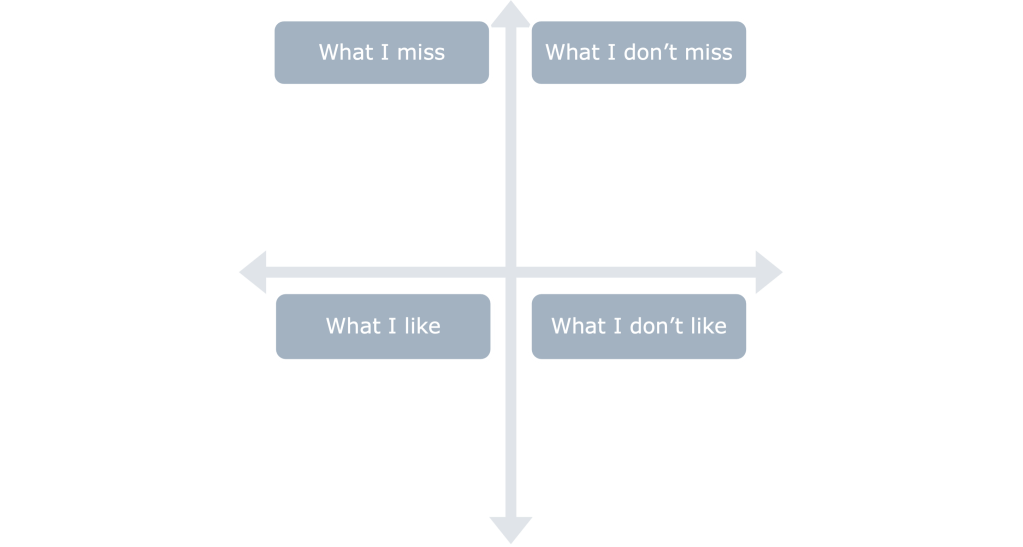
She encouraged both families to reflect now on what they are missing (or not) and what they liked (or not) at ‘home’ using the chart pictured below (in a similar way to the previous one).
Janet gave to Fred and Megan the workbook, ‘Returning Well: Your Guide to Thriving Back ‘Home’ After Serving Cross-Culturally’ by Melissa Chaplin

She said, “This workbook is a great resource to work through with a friend, preferably someone who has been through re-entry recently.”
Both couples selected to work through the book ‘The Seven Principles for Making Marriage Work’ by John Gottman and Nan Silver, as their marriage enrichment option.

Janet organised monthly gatherings of cross-cultural workers for Bible study, prayer and a meal, facilitating fellowship within that community. She also organised men’s and women’s retreats every six months, as well as occasional social events and TCK (third culture kid) events including ten-pin bowling or trampolining. Janet considered delegating the organising of these events due to a lack of time.Follow-up of cross-cultural workers in final re-entry, like Fred, Megan and their children, can profitably continue for a number of years, although contact will typically decrease in frequency over time.
Janet’s follow-up of the families resulted in both families being better resourced for the future.
* All names of people and places in this blog have been changed to provide anonymity.
Acknowledgements
Thank you to David Bird for his editorial assistance.
References
Ash, C. (2017) Zeal Without Burnout: Seven Keys to a Lifelong Ministry of Sustainable Sacrifice. U.K.: The Good Book Company.
Austin, C. (1983) ‘Re-entry Stress: The Pain of Coming Home’, Evangelical Missions Quarterly, 19(4).
Chaplin, M. (2015) Returning Well: Your Guide to Thriving Back ‘Home’ After Serving Cross-Culturally. Singapore: Newton Publishers.
Dallman, J. (2021) Staying Well: Highlighting Hazards, Highlighting Health for Missionaries in Japan.
Ennis, L. and Brian, L. (2017) Receiving Them Well: A Guide on How to Support Your Loved One Returning From Humanitarian Aid or Missionary Work. USA.
Knell, M. (2006) Burn Up or Splash Down: Surviving the Culture Shock of Re-entry. Downers Grove, IL: Intervarsity Press.
Koteskey, R.L. and Koteskey, B. (2007) ‘We’re Going Home: Reentry for Elementary Children’. New Hope International Ministries. Available at: http://www.missionarycare.com/ebooks/Childrens_Reentry_Book.pdf.
Macnaughtan, H. (2006) Re-Entry the Home Coming Missionary: Can a Sending Church be a Successful Receiving One? Macnaughtan, Helen. Available at: https://books.google.com.au/books?id=crBfPQAACAAJ.
O’Donnell, K. (ed.) (2002) Doing Member Care Well: Perspectives and Practices From Around the World. Pasadena, CA: William Carey Library.
Peterson, E. (2004) ‘The Pastor’s Sabbath’, Christianity Today, May.
 Member Caring